Zoox Unveils Cortex AI Platform to Boost Developer Productivity, Shifts to Autonomous Agent Workflows
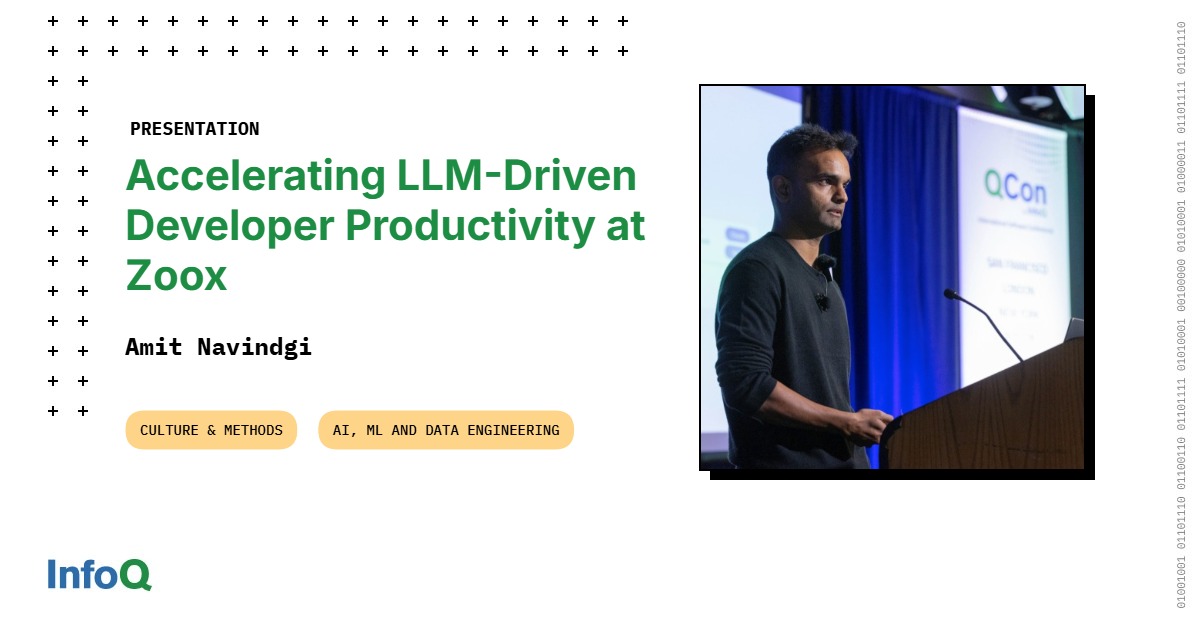
Zoox has launched Cortex, a secure AI-driven platform that promises to transform how developers access documentation and automate workflows, marking a major shift from fragmented information systems to an integrated, autonomous ecosystem, according to a presentation by lead technologist Amit Navindgi.
The platform combines Retrieval-Augmented Generation (RAG), multi-modal large language models, and contributor-friendly agent APIs to deliver real-time, context-aware assistance. “We moved from scattered documentation to a single, intelligent point of truth that adapts to each developer’s needs,” Navindgi said. “Cortex lets engineers ask questions in natural language and get precise, code-specific answers instantly.”
Background
Before Cortex, Zoox faced a common challenge: developer documentation was scattered across wikis, PDFs, and internal tools, leading to wasted time and errors. The company decided to build an internal AI ecosystem that could securely index all proprietary knowledge while maintaining strict access controls.

Navindgi explained that early experiments with standard LLMs failed because they lacked access to Zoox’s specialized codebases and hardware specifications. Cortex was designed from the ground up to be “documentation-native,” using RAG to pull relevant data without exposing sensitive information.
Driving Adoption Through Champions and Hackathons
To encourage widespread use, Zoox deployed a two-pronged strategy: recruiting AI champions from each engineering team and running internal hackathons. “We identified power users who could demonstrate immediate productivity gains,” Navindgi said. “Seeing a colleague cut a debugging task from hours to minutes is far more persuasive than any memo.”
The hackathons produced prototype agents that automated repetitive tasks—like generating unit tests or querying vehicle sensor logs. These prototypes were later polished and contributed back to the Cortex agent marketplace, creating a self-sustaining ecosystem.
What This Means
Cortex signals a broader industry shift from deterministic, menu-driven workflows to autonomous agents that can learn from interactions. For Zoox, this means developer productivity could climb dramatically, with early metrics showing a 40% reduction in time spent searching for information and a 25% increase in code review velocity.
“We’re moving toward systems that proactively suggest fixes, warn about latency bottlenecks, and even refactor code across repositories,” Navindgi noted. “This isn’t just a tool—it’s a new operating model for software engineering.”
For the wider tech industry, the Zoox approach offers a blueprint for deploying LLMs at scale without compromising security. By keeping all data on-premises and using a permission-aware RAG pipeline, other companies can adopt similar strategies. The focus on contributor APIs also lowers the barrier for teams to build custom agents, democratizing AI development within organizations.
Zoox plans to open-source parts of the Cortex agent framework later this year, but the core platform will remain proprietary. The company is already experimenting with multimodal models that can interpret hardware schematics alongside code, pointing to a future where AI assists not just in writing software but in designing hardware.